
Tactically Analyzing What Went Wrong in App State’s 47-14 Loss
 ASF StaffOct 1, 2025 · 4 min read · 13 views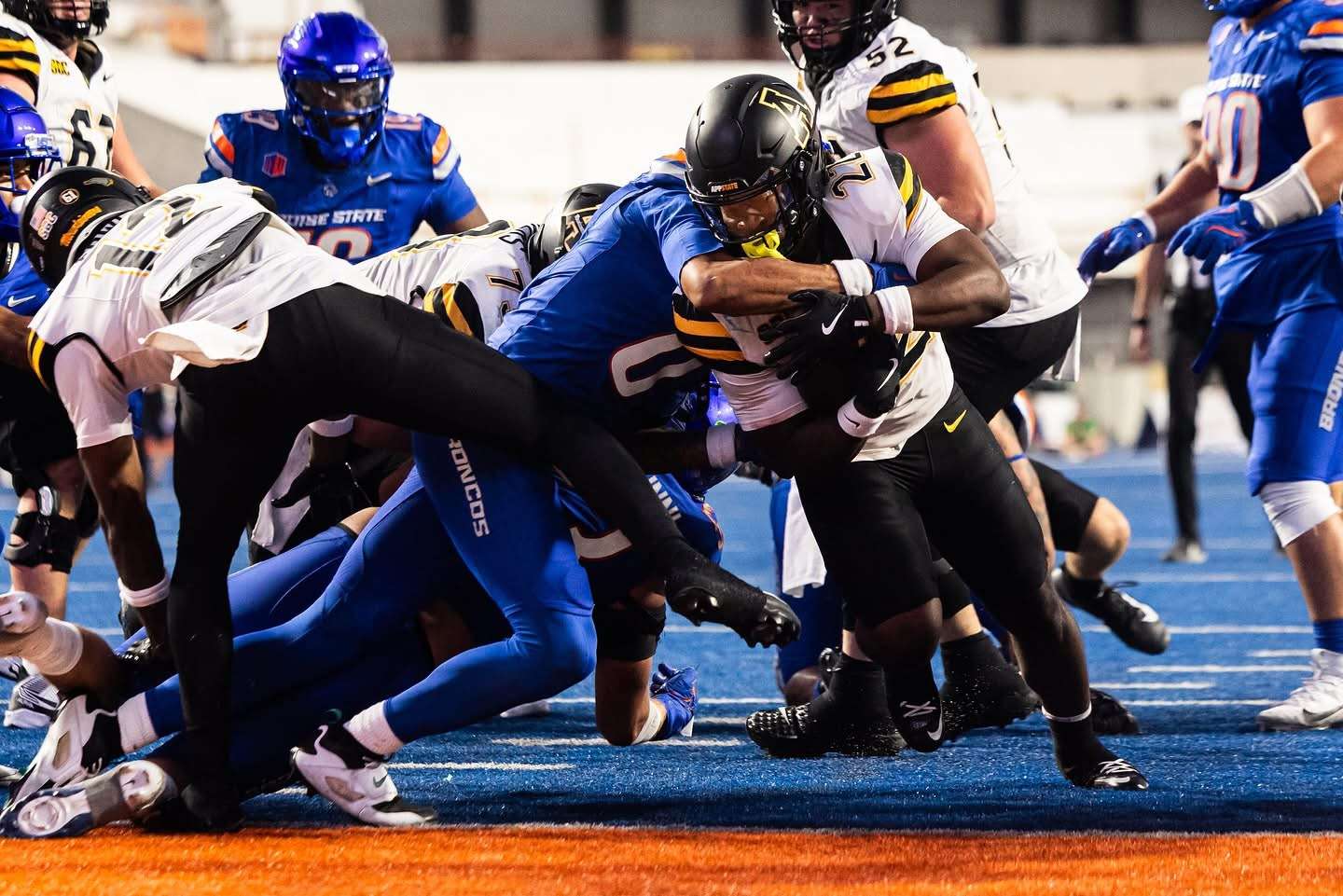
Image Courtesy Of App State Facebook
Appalachian State’s devastating 47-14 defeat at Boise State wasn’t the result of a single catastrophic moment, but rather a comprehensive organizational failure that exposed every weakness the Mountaineers had managed to mask through their first three games. The loss revealed fundamental flaws that demand immediate attention if App State hopes to compete effectively in Sun Belt Conference play.
Offensive Line Collapse.
This is the Root of All Problems. The most glaring failure centered on App State’s inability to provide adequate protection for quarterback AJ Swann, who absorbed five sacks against Boise State’s pass rush. This is a complete breakdown of the offensive line’s primary responsibility and created a domino effect that crippled the entire offensive game plan.
The constant pressure prevented Swann from establishing any rhythm in the pocket, forcing him into hurried throws and limiting his ability to progress through his reads. When quarterbacks can’t trust their protection, it affects every aspect of the passing game, from route timing to receiver confidence.
The five sacks weren’t just statistical failures, they are drive-killing plays that consistently placed App State in unfavorable down-and-distance situations. Third-and-long scenarios became virtually impossible to convert when the quarterback faced immediate pressure on every passing down.
Passing Game Ineffectiveness:
App State’s aerial attack produced a season-low 65 passing yards, a statistic that reveals the complete breakdown of their offensive execution. This anemic production occurred despite having talented receivers like Jaden Barnes and Izayah Cummings, who had been productive in previous contests.
The lack of passing yards wasn’t solely due to protection issues, it also show poor decision-making, inaccurate throws, and an inability to find open receivers against Boise State’s coverage schemes. When an offense manages just 65 passing yards, it indicates systematic problems that extend beyond individual player failures.
The passing game struggles forced App State into a one-dimensional offensive approach, allowing Boise State’s defense to focus on stopping the run while applying consistent pressure on obvious passing situations.
Catastrophic Turnover Problems
App State’s most costly mistakes came in the form of two interceptions returned for touchdowns, which effectively ended any realistic chance of competing with Boise State’s high-powered offense. These weren’t just turnovers, they were momentum-crushing scores that created an insurmountable deficit.
The first pick-six occurred with 1:49 remaining in the opening quarter, extending Boise State’s lead to 14-0 and immediately placing pressure on App State’s struggling offense. The second defensive touchdown came with 10:21 remaining in the game, sealing the Mountaineers’ fate when they desperately needed to generate points.
These interception returns for touchdowns represented a continuation of App State’s season-long struggles with ball security, dating back to their red zone interceptions against Southern Miss. Against quality opposition, such carelessness with the football becomes catastrophic rather than merely concerning.
Fourth Down Failure
App State’s defense faced a crucial fourth-and-5 situation with 1:53 remaining in the third quarter, representing their best opportunity to force a punt and potentially create momentum. Instead, Boise State quarterback Maddux Madsen completed a pass to convert the first down, leading directly to a 29-yard touchdown pass to freshman Quinton Brown.
This failure to get off the field in a critical situation exemplified App State’s inability to make game-changing plays when they mattered most. Championship-caliber teams create stops in fourth-down situations, the Mountaineers allowed Boise State to extend drives and score touchdowns instead.
Inability to Match Opponent’s Execution Level
Throughout the contest, App State appeared pressured by the precision and execution level that Boise State showed on both sides of the ball. While the Broncos executed their game plan flawlessly, the Mountaineers struggled with basic fundamentals like pass protection, ball security, and third-down conversions.
Maddux Madsen’s career-high 321 passing yards and four touchdown passes occurred largely because App State’s secondary couldn’t match the timing and precision of Boise State’s passing attack. When opponents complete 25 of 37 passes for over 300 yards, it indicates coverage breakdowns and communication failures.
No Answers Found In Coaching Adjustments
Perhaps most concerning was App State’s inability to make meaningful halftime adjustments that addressed their first-half struggles. The Mountaineers continued experiencing the same problems in the second half, suggesting a coaching staff that couldn’t identify solutions to Boise State’s systematic advantages.
The Verdict
Saturday’s loss revealed that App State’s early-season success masked big problems that quality opponents can exploit. Until the Mountaineers address their pass protection, ball security, and execution under pressure, similar disappointments will define their remaining schedule against conference competition.
Comments here are the same thread as the feed and the forum — one conversation, three places.